

There is a version of the London Spirit story that reads as a punchline. A consortium of Silicon Valley operators: the sitting chief executives of Google, Microsoft, and Adobe among them put up £145 million for a 49% stake in a franchise that plays a four-week, 100-ball competition, has never won the men’s title, and whose best finish is a third place from 2022. The valuation the deal implied, roughly £295 million, came in at more than double what any other team in The Hundred fetched. On a spreadsheet built around franchise cash flow, that is not a rich price. It is an indefensible one.
So the interesting question is not whether they overpaid. It’s what they think they bought. Because the buyer list tells you they weren’t pricing a cricket team at all.
What’s actually on the ticket
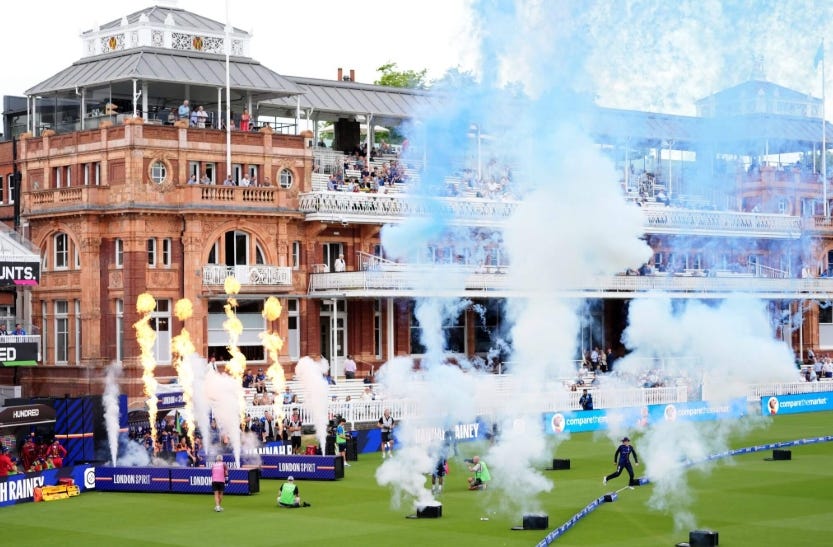
The Spirit’s home is Lord’s the ground English cricket calls the home of the sport, owned and operated by Marylebone Cricket Club, the 239-year-old institution that still serves as the guardian of the Laws of the game. That last detail is the one that reframes the whole transaction. MCC doesn’t just own the most storied address in cricket; it writes the rules the entire global game plays by.
A 49% stake in the Spirit, then, is not really an equity position in a mid-table franchise. It is the entry ticket to a commercial relationship with that institution and, through it, a line into cricket’s global fanbase north of a billion people, overwhelmingly concentrated in South Asia, and structurally under-monetized on exactly the axes Silicon Valley knows how to attack: direct-to-consumer, data, digital rights, and platform distribution. You don’t pay a control premium for the team. You pay it for the address and the option value attached to it.
That’s the mispricing that isn’t. Priced as a franchise, £295 million is absurd. Priced as call option on the global digital monetization of the world’s second-most-followed sport — anchored to its single most trusted brand — it starts to look like a rational entry into a market these operators believe is a decade behind where it should be.
Why these buyers, specifically
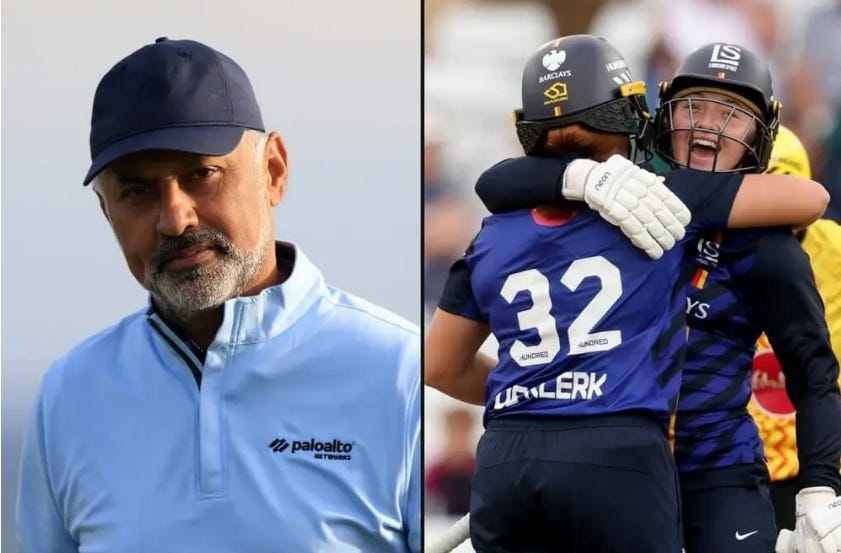
Sports-vanity money looks a certain way: a hedge-fund principal buys a Premier League club, a private-equity shop buys a stadium’s worth of cash flow. This isn’t that. The consortium led by Nikesh Arora of Palo Alto Networks, with Silver Lake’s Egon Durban and Times Internet’s Satyan Gajwani in the mix alongside Sundar Pichai, Satya Nadella, and Shantanu Narayen reads as a platform-and-distribution roster, not a trophy cabinet.
Arora ran a decade at Google before Palo Alto. Gajwani is the tell most people miss: he’s a co-founder of Major League Cricket and vice-chairman of Times Internet, which means the consortium has a direct operational line into both the U.S. cricket build-out and India’s digital media machine. Heavy Indian-American representation across the group isn’t incidental. It’s an alignment with the two markets that decide whether cricket’s next decade of value gets captured — the enormous domestic Indian audience and the diaspora demand that MLC is trying to convert in the States.
The unlikely alliance is the whole story
Which brings us to the friction, and to why the deal is genuinely novel rather than just expensive. You are grafting Silicon Valley operating culture onto a 239-year-old members’ club — an institution defined by tradition, waiting lists, and a self-appointed duty to protect the game from exactly this kind of disruption. The cultural distance between “move fast” and “guardian of the Laws” is the entire risk, and the entire point.
The governance is engineered around that tension. MCC kept 51% a gift from the ECB it chose not to sell down and retains control of the board, while the tech consortium takes the minority stake plus real operational influence. That structure is doing something specific: it lets the institution keep its hand on the wheel and its identity intact while importing operator capability it could never build in-house. It is, in effect, the sports-M&A equivalent of a strategic acquisition where the acquirer promises to leave the founding team in charge. Whether that promise survives contact with a P&L is the thing to watch.
One year on: what operator money actually changed
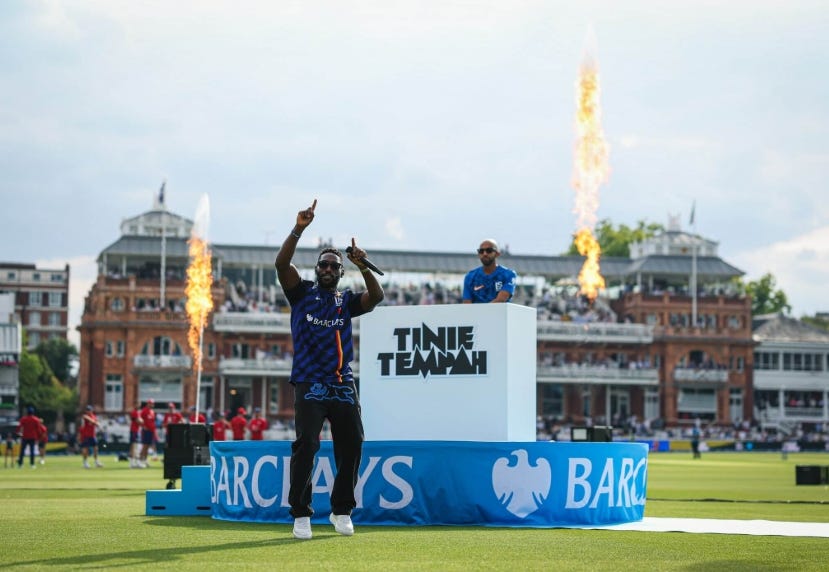
The first season under the new ownership is the tell on execution, and the early evidence is exactly what you’d predict when operators take over a heritage asset. The visible change came in the brand, not the batting order: a full rebrand run through VCCP and SomeOne, the new identity projected onto Lord’s Media Centre, a rebuilt site and social presence, and a blue-chip commercial stack assembled fast — Barclays as a partner, Nike on the kit in what’s reported as Nike’s first deal in The Hundred.
That’s the pattern worth internalizing. The money did not buy a better XI overnight. It bought a brand reset and a commercial reset the two things operators can actually move quickly while the sporting product stays on its own, slower clock. The women’s side carries the pedigree here, as 2024 Women’s Hundred champions; the men remain the unproven half of the asset. The commercial thesis and the sporting thesis are not running on the same timeline, and pretending otherwise is how ownership groups talk themselves into disappointment.
The signal
For anyone underwriting deals at the intersection of sport, technology, and capital, London Spirit is a clean case study in four things:
Price the address, not the team. The sharpest capital in sports right now is increasingly paying for access, distribution, and heritage IP — option value on a fanbase — rather than for franchise cash flow. The multiple only makes sense once you reprice what’s being bought.
Pair heritage with operators, and engineer the governance. The most sophisticated version of this deal isn’t a takeover; it’s a structured alliance that keeps institutional trust intact while importing capability. The cap table and the board seats are the strategy, not the paperwork.
Follow the value migration. The upside sits in direct-to-consumer monetization of large, under-served fanbases. Whoever controls the trusted brand and the distribution layer controls the return. This consortium is trying to own both ends.
Culture is the integration risk. Same as any platform acquisition. The question is never whether Silicon Valley can build the commercial machine — it’s whether a 239-year-old club lets it, and for how long. That’s the one line item no model prices, and the one worth watching most.
STA Field Notes tracks commercial signals at the intersection of sports, technology, and capital. Reply or reach out at @stemack.